
Email Marketing
How segmentation, testing, and design turned a failing email program around
Year
2025
Summary
Unsubscribes were climbing and growth was flat. I rebuilt the email program with new templates, audience segments, and A/B tests, increasing click rate by 433%.
Company
NexiGo
Email Marketing
How segmentation, testing, and design turned a failing email program around
Year
2025
Summary
Unsubscribes were climbing and growth was flat. I rebuilt the email program with new templates, audience segments, and A/B tests, increasing click rate by 433%.
Company
NexiGo
Email click rate up by 433% with targeted campaigns
Through a series of email marketing campaigns, I reinvigorated our email marketing strategy. This months-long project involved unifying the email aesthetic, running A/B tests, and creating segments to target subscribers with the content that was relevant to them.
By the end, I increased the average click rate by 433%.
Through a series of email marketing campaigns, I reinvigorated our email marketing strategy. This months-long project involved unifying the email aesthetic, running A/B tests, and creating segments to target subscribers with the content that was relevant to them.
By the end, I increased the average click rate by 433%.
Before
Open Rate
16.07%
Unsubscribed
54
Click Rate
1.13%
Marked as Spam
0


After
Open Rate
50.62%
Unsubscribed
2
Click Rate
6.04%
Marked as Spam
1

The problem with our old email strategy
My team lacked a formal strategy for email campaigns, and it was beginning to cost us subscribers. As we began to ramp up our email marketing efforts, there was a big uptick in people unsubscribing and marking us as spam. And to make matters worse, there wasn’t much growth to make up for it.
The issue was two-fold.
My team lacked a formal strategy for email campaigns, and it was beginning to cost us subscribers. As we began to ramp up our email marketing efforts, there was a big uptick in people unsubscribing and marking us as spam. And to make matters worse, there wasn’t much growth to make up for it.
The issue was two-fold.
Issue 1: Two distinct styles were used
To start, multiple teams were creating and sending their own emails. This led to a visual and tonal shift from email to email that left subscribers unable to predict what was going to come next. Without a unified brand voice, we could not build a long-term relationship with our subscribers.
To start, multiple teams were creating and sending their own emails. This led to a visual and tonal shift from email to email that left subscribers unable to predict what was going to come next. Without a unified brand voice, we could not build a long-term relationship with our subscribers.
Issue 2: Emails were not targeted
Second, emails were not targeted. Previously, they were sent as a way to advertise releases and holiday sales to everyone on our subscriber list, even those who were unlikely to buy the advertised product. As a result, our open rate and click rate were declining month over month.
Second, emails were not targeted. Previously, they were sent as a way to advertise releases and holiday sales to everyone on our subscriber list, even those who were unlikely to buy the advertised product. As a result, our open rate and click rate were declining month over month.
My approach
In response to our dipping metrics, I took ownership of the email marketing account and formalized our strategy, creating templates, building subscriber segments, and conducting A/B tests. I also created lead magnets to increase growth.
Here’s what that looked like.
In response to our dipping metrics, I took ownership of the email marketing account and formalized our strategy, creating templates, building subscriber segments, and conducting A/B tests. I also created lead magnets to increase growth.
Here’s what that looked like.
Creating a new look
As a first step, emails needed a makeover. They needed to be created quickly, and they needed to look professional and consistent.
Previously, there were two styles being used: one by the overseas team (Style A) and one by the American team (Style B). My goal was to combine the best of these two approaches.
As a first step, emails needed a makeover. They needed to be created quickly, and they needed to look professional and consistent.
Previously, there were two styles being used: one by the overseas team (Style A) and one by the American team (Style B). My goal was to combine the best of these two approaches.
Style A
Like Style A, I wanted to make our emails polished and easy to skim by using a consistent template, clear CTAs, and solid information hierarchy.
Like Style A, I wanted to make our emails polished and easy to skim by using a consistent template, clear CTAs, and solid information hierarchy.

Open Rate
29.8%
Click Rate
1.3%
Style B
Like Style B, I wanted to bring a layer of authenticity by using product photography instead of digital renders.
Like Style B, I wanted to bring a layer of authenticity by using product photography instead of digital renders.

Open Rate
83.9%
Click Rate
2.8%
Style B's unusually high open rate reflects strong timing and subject line rather than design (context worth keeping in mind when comparing the three approaches).
Style B's unusually high open rate reflects strong timing and subject line rather than design (context worth keeping in mind when comparing the three approaches).
New Style
I developed a new style that combined the best of both: authentic photography with strong CTAs.
I developed a new style that combined the best of both: authentic photography with strong CTAs.

Open Rate
49.3%
Click Rate
6%
Building a component and asset library to standardize the look
As I developed a new look for our marketing emails, I also built it into reusable Figma components. This enabled my teammates to step in and quickly create emails in our new style.
As I developed a new look for our marketing emails, I also built it into reusable Figma components. This enabled my teammates to step in and quickly create emails in our new style.
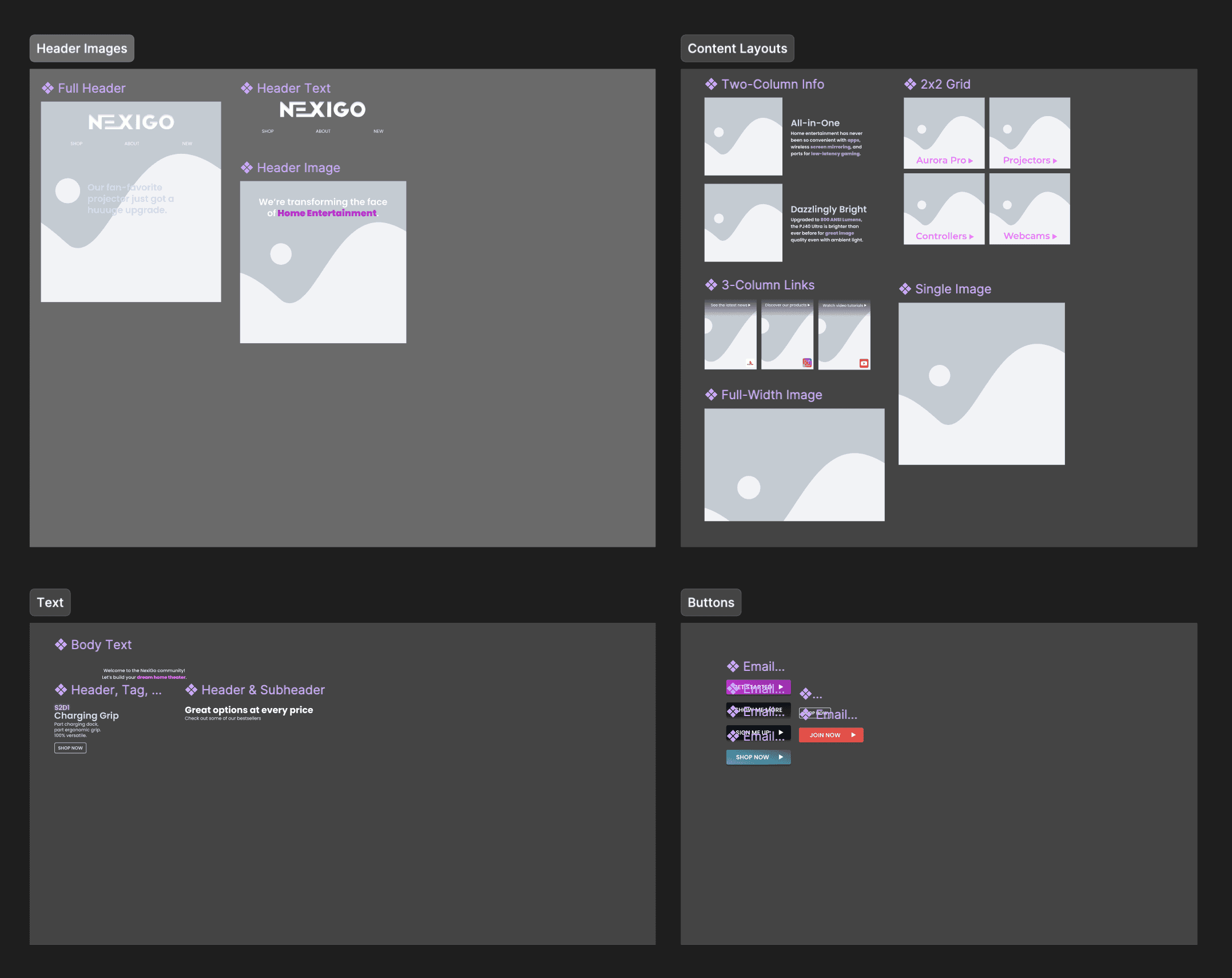
At the same time, I led an initiative to build out our collection of product photos that could be pasted into a variety of emails.
At the same time, I led an initiative to build out our collection of product photos that could be pasted into a variety of emails.


The result was a collection of assets that could be quickly combined. The drag-and-drop library cut down the amount of time it took to build emails, taking it from a task that took around 3–4 hours to one that takes only 10 minutes.
The result was a collection of assets that could be quickly combined. The drag-and-drop library cut down the amount of time it took to build emails, taking it from a task that took around 3–4 hours to one that takes only 10 minutes.
Targeting our audience
Next, I created segments that would help us target customers. This would enable me to send out only relevant content that subscribers would engage with.
Next, I created segments that would help us target customers. This would enable me to send out only relevant content that subscribers would engage with.
Creating targeted segments
First, I broke down the subscriber list by the types of products that they’ve viewed or purchased. I created segments for the following product categories:
Webcams
Projectors under $1K
Projectors over $1K
Nintendo Switch accessories
PS5 accessories
First, I broke down the subscriber list by the types of products that they’ve viewed or purchased. I created segments for the following product categories:
Webcams
Projectors under $1K
Projectors over $1K
Nintendo Switch accessories
PS5 accessories
I also created a segment for subscribers who are less engaged, so they would only get the really important stuff (like big sales and product launches).
I also created a segment for subscribers who are less engaged, so they would only get the really important stuff (like big sales and product launches).
Finally, I created segments based on location, so that any location-based sales and giveaways would only be advertised in available regions.
Finally, I created segments based on location, so that any location-based sales and giveaways would only be advertised in available regions.
Fixing deliverability score
Better targeting didn't just improve engagement; it significantly improved our sender reputation and long-term deliverability.
Within 6 months, our Klaviyo deliverability score had increased from 28 to 72. Our spam rate dropped from 0.14% to 0.07%, our bounce rate dropped from 2.52% to 1.39%, and our unsubscribe rate dropped from 1.30% to 1.06%.
Better targeting didn't just improve engagement; it significantly improved our sender reputation and long-term deliverability.
Within 6 months, our Klaviyo deliverability score had increased from 28 to 72. Our spam rate dropped from 0.14% to 0.07%, our bounce rate dropped from 2.52% to 1.39%, and our unsubscribe rate dropped from 1.30% to 1.06%.
Formalizing strategy with A/B Testing
To formalize the email strategy, I ran A/B tests to find the headlines and layouts that resonated best with our subscribers.
To formalize the email strategy, I ran A/B tests to find the headlines and layouts that resonated best with our subscribers.
Short vs Long
First, I wanted to test whether shorter or longer emails would get us higher click rates.
First, I wanted to test whether shorter or longer emails would get us higher click rates.
Short
All content can be seen without scrolling
All content can be seen without scrolling
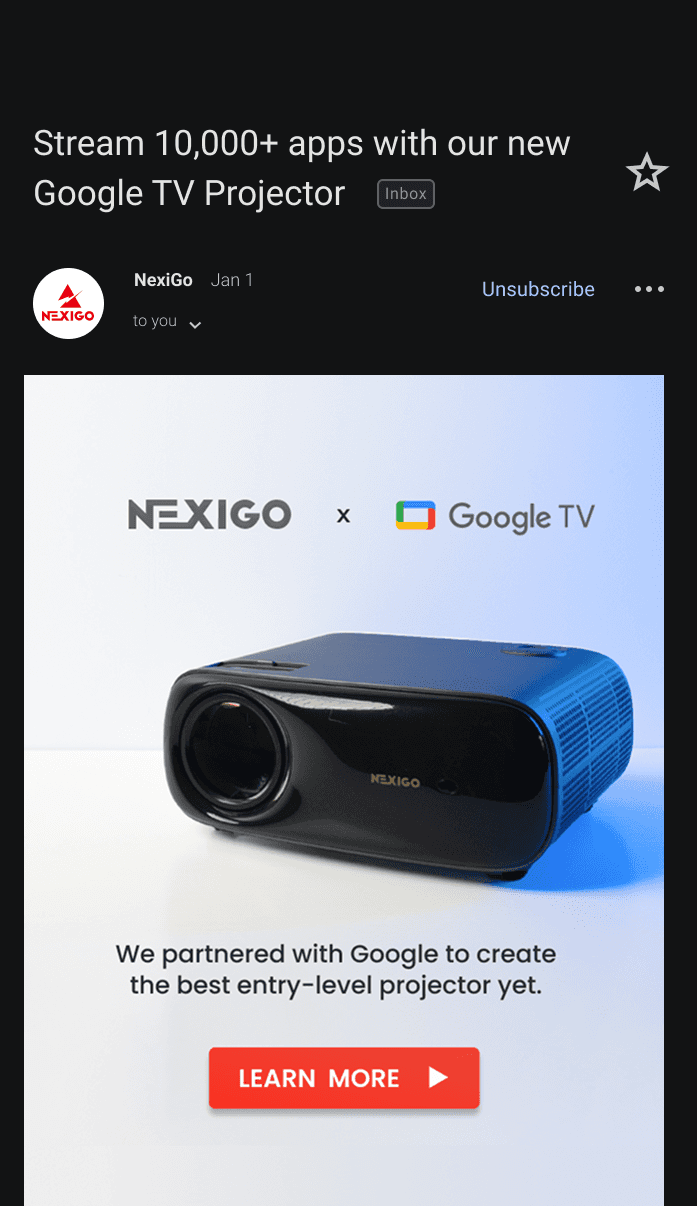
Open Rate
54.92%
Click Rate
7.1%
Long
Some content falls below the fold
Some content falls below the fold

Open Rate
58.48%
Click Rate
5.83%
The results suggested that 22% more people click on shorter emails compared to emails that require scrolling.
Based on these findings, we started condensing emails, using them as a vehicle to redirect the reader, rather than using them as a hub for information.
The results suggested that 22% more people click on shorter emails compared to emails that require scrolling.
Based on these findings, we started condensing emails, using them as a vehicle to redirect the reader, rather than using them as a hub for information.
Dollar Value Saved vs Percentage Off
The next test tackled promotional messaging: dollar value saved versus percentage off.
The next test tackled promotional messaging: dollar value saved versus percentage off.
Dollar Value Saved
Sale is described with the total dollar value removed from the total
Sale is described with the total dollar value removed from the total

Open Rate
51.61%
Click Rate
2.85%
Percentage Off
Sale is described with total percentage removed from the total
Sale is described with total percentage removed from the total
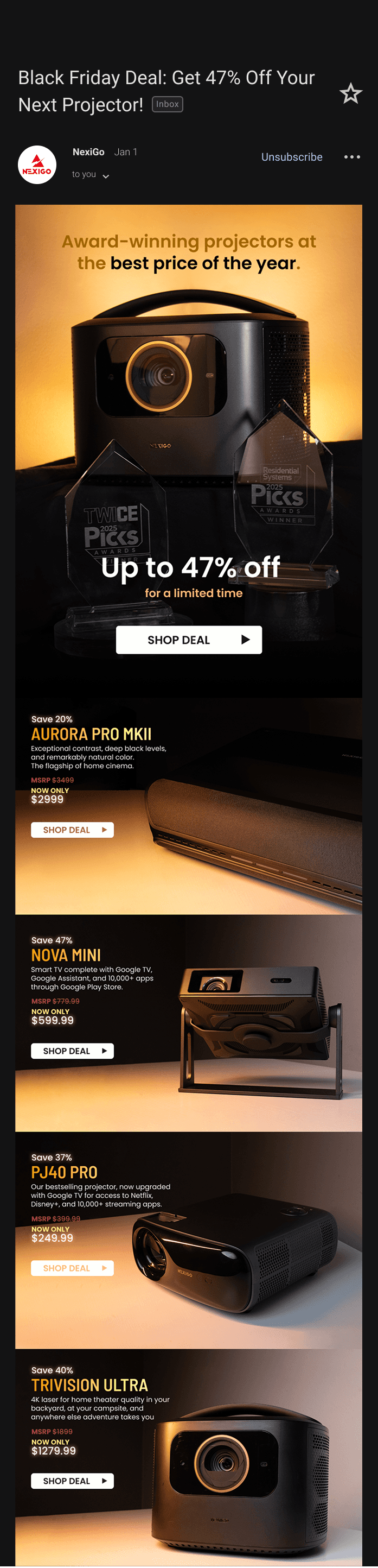
Open Rate
53.63%
Click Rate
4.43%
We found that both open rate and click rate improved when sales were advertised with percentage savings, rather than dollar savings.
We found that both open rate and click rate improved when sales were advertised with percentage savings, rather than dollar savings.
Free Tips & Downloadables
With retention stabilized, it was time to grow our subscriber list. To do this, I built a lead magnet for our flagship projectors.
With retention stabilized, it was time to grow our subscriber list. To do this, I built a lead magnet for our flagship projectors.
PDF Guide
The lead magnet took the form of a downloadable PDF guidebook of recommended projector settings.
The lead magnet took the form of a downloadable PDF guidebook of recommended projector settings.

Popup
This guidebook would be offered in a popup that only appeared on relevant pages (support center and product listing). Anyone who gave their email address on the popup would get the guidebook delivered to their inbox for free.
This guidebook would be offered in a popup that only appeared on relevant pages (support center and product listing). Anyone who gave their email address on the popup would get the guidebook delivered to their inbox for free.


The guidebook had an 83.5% open rate and 56.5% click rate (well above our campaign averages) and grew our subscriber list by 3% within 30 days.
The guidebook had an 83.5% open rate and 56.5% click rate (well above our campaign averages) and grew our subscriber list by 3% within 30 days.
Outcome
The new strategy worked. We started gaining instead of losing new subscribers. Some metrics improved dramatically (like click rate improving by 433%), while others showed noticeable but modest improvement (like unsubscribe rate dropping by 18%).
Outcome
The new strategy worked. We started gaining instead of losing new subscribers. Some metrics improved dramatically (like click rate improving by 433%), while others showed noticeable but modest improvement (like unsubscribe rate dropping by 18%).
Metric | Before | After |
|---|---|---|
| Open Rate | 37.3% | 52.6% |
| Click Rate | 1.96% | 8.52% |
| Growth Rate | -23.8% | 9.94% |
| Deliverability Score | 28 | 72 |
| Spam Rate | 0.14% | 0.07% |
| Unsubscribe Rate | 1.30% | 1.06% |
| Bounce Rate | 2.52% | 1.39% |
| Time to Make a Single Email | 3–4 hours | 10 minutes |